


Have you ever wondered what the best aging of Parmigiano Reggiano is? The answer is "it depends"! There isn't one best aging regardless of use; it all depends on how we want to use the Parmigiano Reggiano. But let's start from the beginning.
What are the aging periods for Parmigiano Reggiano?
Parmigiano Reggiano is among the most well-known and sold Italian cheeses in our country and abroad. Among its distinguishing elements, in addition to its characteristic shape, is undoubtedly its aging, which is one of the most complex and delicate phases of Parmigiano production: it determines the organoleptic characteristics of the finished product.
According to the Parmigiano Reggiano PDO production regulations, the minimum aging is 12 months. However, this cheese reaches its ideal maturation, the moment when it begins to express all its most typical organoleptic characteristics, at around 24 months. It can also age longer, up to 36 or 48 months, developing even richer and more complex aromas and flavors than a 24-month Parmigiano.
What happens during the aging period
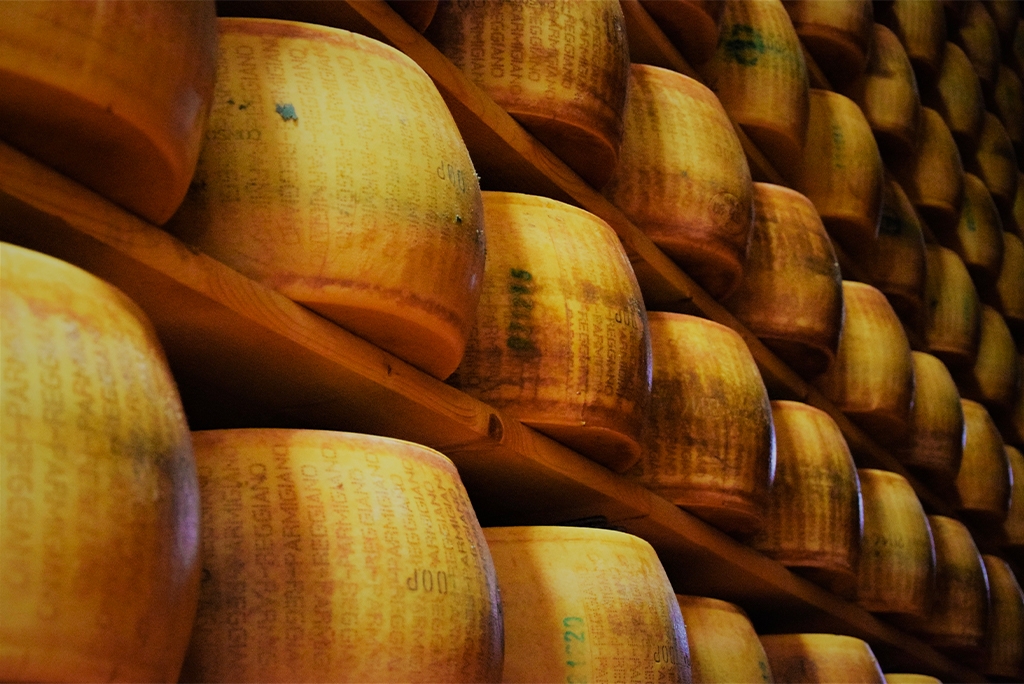
After processing, the Parmigiano wheels are left to rest on long wooden shelves inside the aging warehouses, where the temperature typically settles around 18°C. During these months of maturation, the cheese gradually dries out, and a natural rind forms, which is not treated at all, making it completely edible. The interior of the wheel gradually acquires its typical grainy texture, which will change over time depending on the aging period.
But from a chemical point of view, what happens during the aging process? Due to the enzymes of lactic acid bacteria, a protein breakdown process called proteolysis is activated, whereby proteins are broken down into progressively smaller particles. For this reason, long-aged Parmigiano Reggiano is a particularly digestible cheese.
Parmigiano Reggiano aging labels
After the minimum aging of 12 months, the wheels that are deemed suitable after inspection can continue to age. Wheels that pass inspections from 18 months onwards will receive the marks and the dotted writing of the Protected Designation of Origin.
The official aging categories are as follows:
- Over 18 months: Lobster Label
- Over 22 months: Silver Label
- Over 30 months: Gold Label
What is the best aging for Parmigiano depending on its use
The different aging periods give Parmigiano Reggiano different sensory characteristics. Let's look broadly at the peculiarities associated with each aging period and the most suitable uses for each maturation stage.
- Aging between 12 and 18 months: at this stage, Parmigiano is characterized by a delicate aromatic taste, with notes of milk, yogurt, and fruit. It is recommended as an appetizer ingredient, perhaps alongside mortadella cubes or a few walnut kernels, paired with a good sparkling wine, or to enrich vegetable and fruit salads.
- Aging between 22 and 24 months: at this point, Parmigiano Reggiano reaches its typical organoleptic qualities, presenting itself as crumbly, granular, with a taste between sweet and savory and aromatic notes reminiscent of dried fruit and broth. It is the ideal time to use it in harmony with Traditional Balsamic Vinegar of Modena, or to flavor filled pasta, lasagna, and other traditional first courses of Emilia Romagna.
- Aging between 30 and 36 months: the additional months of aging not only give a more complex aromatic structure and a more decisive taste but also greater crumbliness. At this time, Parmigiano Reggiano is characterized by notes of spices, dried fruit, broth, and a truly flavorful taste, making it ideal as a post-meal treat, to be enjoyed alone, paired with a full-bodied wine.
If you're still hungry for more information on Parmigiano Reggiano aging, we recommend carefully reading the Guide to Parmigiano Reggiano from the Consorzio di Tutela and then, to truly verify the differences between 12, 18, 24, 36... month Parmigiano, to sequentially savor all the versions of Parmigiano from Caseificio San Simone!























