


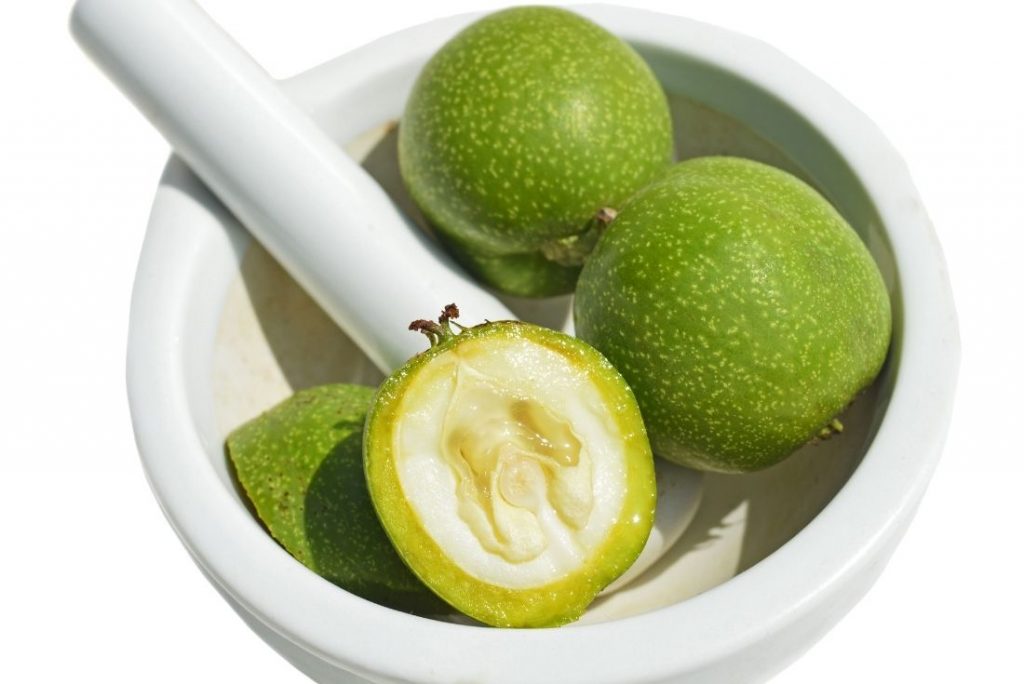
Among the many traditional Emilian liqueurs, one of the most loved and widespread is undoubtedly nocino. As the name suggests, this liqueur is made with walnuts, and in particular with the walnut husk, which is the pulpy part that surrounds the walnut shell. It is prepared in the summer and can be sipped throughout the year, neat or with ice. But how do you make nocino? Let's discover all the preparation secrets together!
Nocino: how it's prepared, between traditions and rituals
To prepare nocino, walnuts are traditionally harvested on St. John's Eve, June 24th, by the woman most experienced in this preparation (which is why grandmothers historically prepare homemade nocino), taking care not to use metal tools that could damage the fruits and thus cause them to oxidize. The preparation ritual dictates that, after harvesting, the walnuts are left to rest overnight outdoors, covered by dew.
In any case, the advice for preparing nocino, whether you want to respect traditional rites or not, is to harvest the fruits between the end of June and the first half of July, when they are still unripe.
Every family historically had its own recipe, in which the proportions between walnuts and alcohol varied significantly, and even today that nocino has moved out of the home to be produced by specialized companies, there is no single recipe, but many different versions. Let's discover the "basic" one.
After harvesting, the walnuts, not stripped of their husks, should be cleaned and dried, then cut into four parts (preferably with a ceramic knife to prevent oxidation) and placed in a very large jar. At this point, sugar should be added (about 800 g for every kg of walnuts) and everything mixed.
After two days, it will be time to add pure 95-proof alcohol, mix well, and let it macerate for about two months, according to tradition until All Saints' Eve (October 31st).
Taking care to stir occasionally, it will then be time to bottle: filter the nocino with a clean cloth and bottle it in sterilized bottles. The advice is to let the nocino rest for a few months, even a year, before savoring it in all its goodness.
How to make nocino: variations of the walnut liqueur
Furthermore, nocino can be flavored as desired with various spices, such as cloves, cinnamon, and juniper berries. For example, the Artisanal Reggiano Nocino found in our Pantry is enriched with cinnamon, coffee, cloves, lemon zest, a mix that makes it even more aromatic and flavorful, for an extraordinary after-dinner liqueur. Less aromatic, but equally good, is the Nocino delle Streghe.























