


On this blog, we've talked many times about how Parmigiano Reggiano is made, but the milk from the cows that produce Italy's most famous cheese also yields another extraordinary product: butter! Today, let's discover how butter is made!
Produced since the Middle Ages, butter is one of the staple ingredients of Italian cuisine. The star of a classic snack – bread, butter, and jam – as well as countless sweet and savory preparations, it is one of the main milk derivatives.
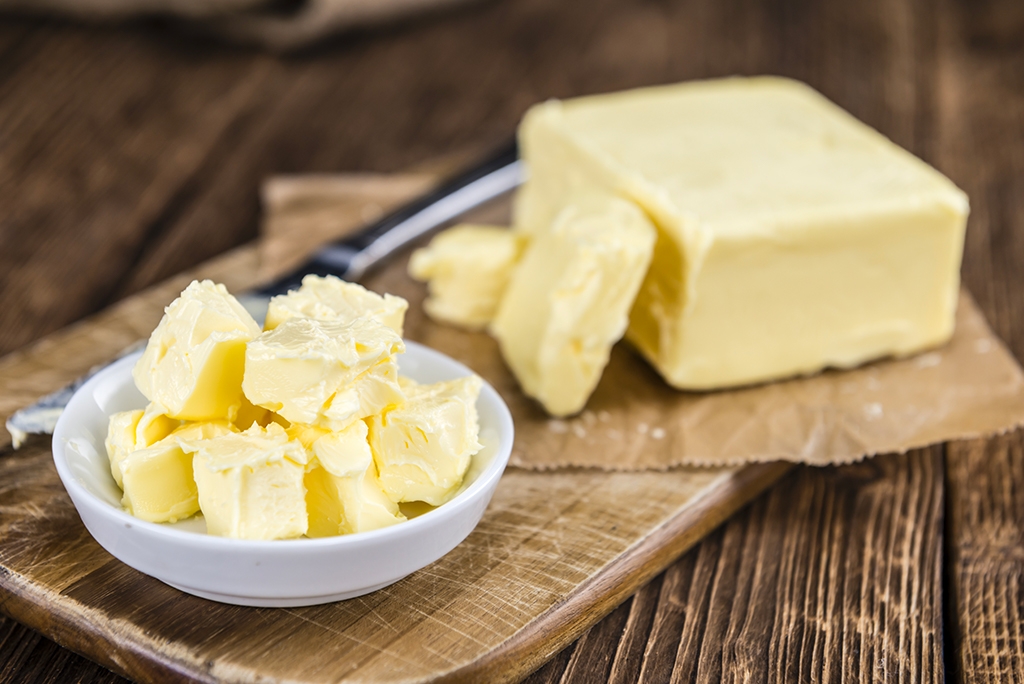
What butter is and how it's made
Butter is a very energetic food, composed of over 82% fat, plus 15% water, and then mineral salts, proteins, and aromatic substances.
Butter can be produced using two different creaming techniques:
- surfacing;
- centrifugation.
When we talk about surfaced butter, the milk is left to rest for a period varying between 8 and 12 hours, during which the fattier part of the milk, being lighter, rises to the surface, separating from the liquid part. The surfaced substance is called cream, or milk cream. This is the production process followed in Italy.
In the case of centrifugal butter, on the other hand, the separation between the fatty and liquid parts occurs through centrifugation of the milk. This typically happens in Nordic countries.
Once the fatty part has been separated from the liquid part, the milk cream is pasteurized at a temperature of around 90°-100°C, then cooled to a temperature of 9-11°C for several hours.
The cream, enriched with special bacterial cultures that cause controlled lactose fermentation, is now ready for churning: this is a cold agitation process of the milk cream, thanks to which the fat globules combine, while the residual liquid part (buttermilk) is removed. This process is called churning.
The butter is then worked until it reaches a homogeneous consistency and finally cut and packaged in wrapped blocks or tubs.
According to Italian law (L. 202/1983), the designation of butter "is reserved for the product obtained from cream derived from cow's milk and the product obtained from cow's milk whey" and cannot contain added fats of other kinds.
At Caseificio San Simone, in addition to many aged Parmigiano Reggiano cheeses, we also produce a butter made with traditional churn butter-making. A product with a "full" flavor, rich in omega 3!
What is clarified butter and how is it made?
Surely you've heard of clarified butter at some point. But do you know what it is? Clarified butter is butter that undergoes a mechanical transformation process aimed at removing water and casein.
This is a delicate bain-marie cooking process during which water evaporates, while casein settles.
The clarified butter thus obtained has a longer shelf life and a very high smoke point (around 170°C), making it ideal for crispy frying (for example, for authentic Milanese cutlets!).
Remember that you can also prepare clarified butter at home from a block of "normal" butter. To discover the production process, take a look at La Cucina Italiana's recipe.























